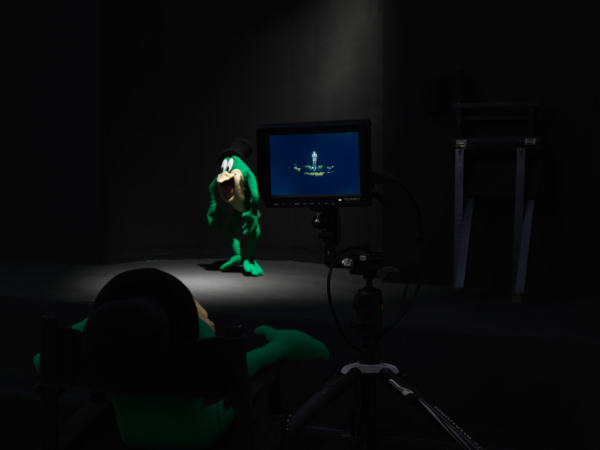
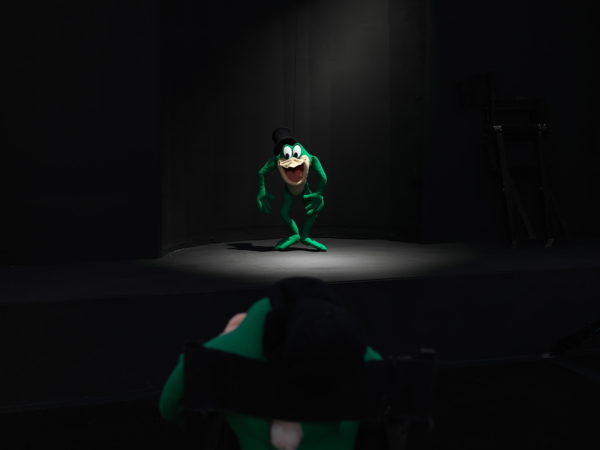
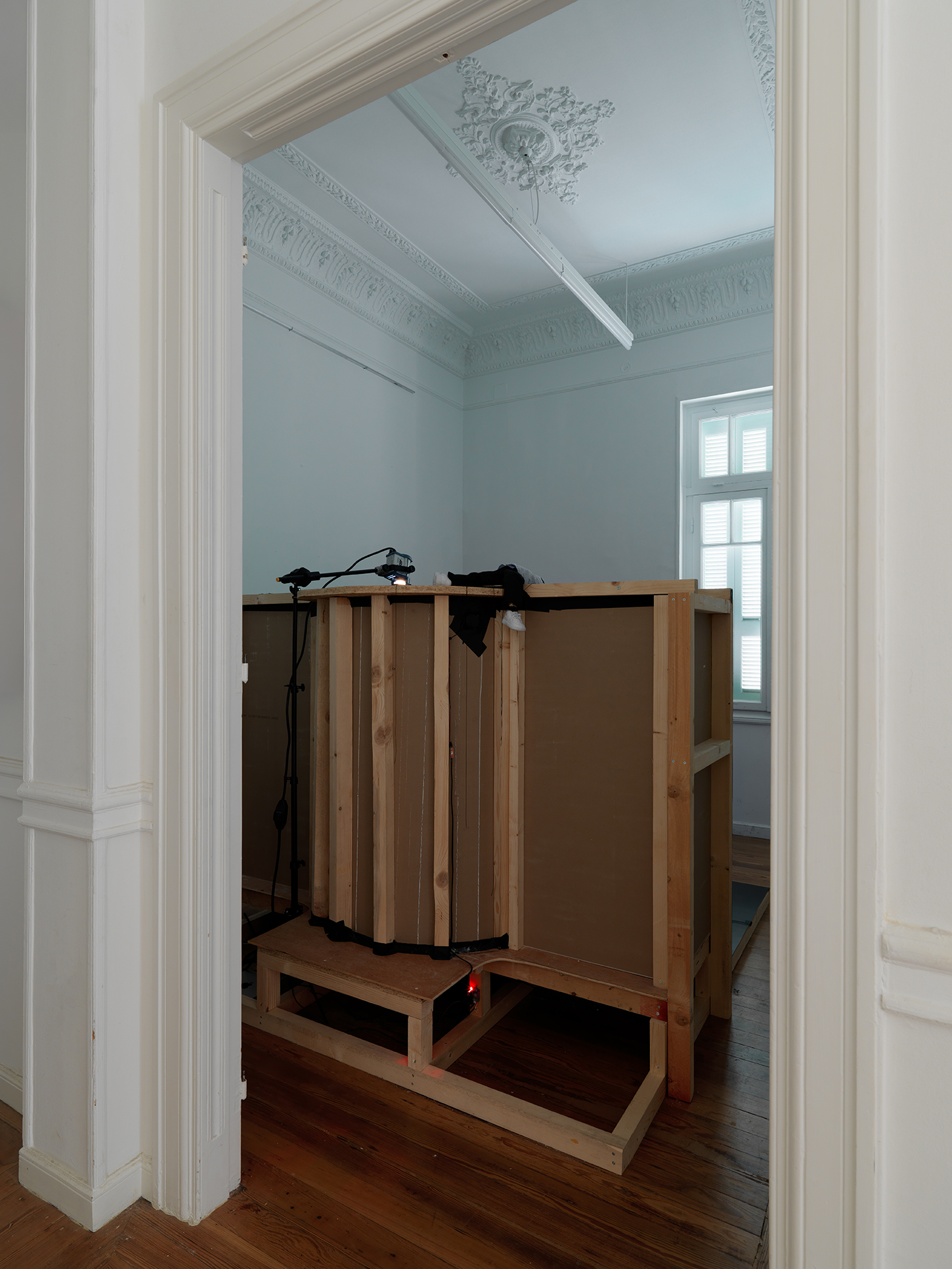
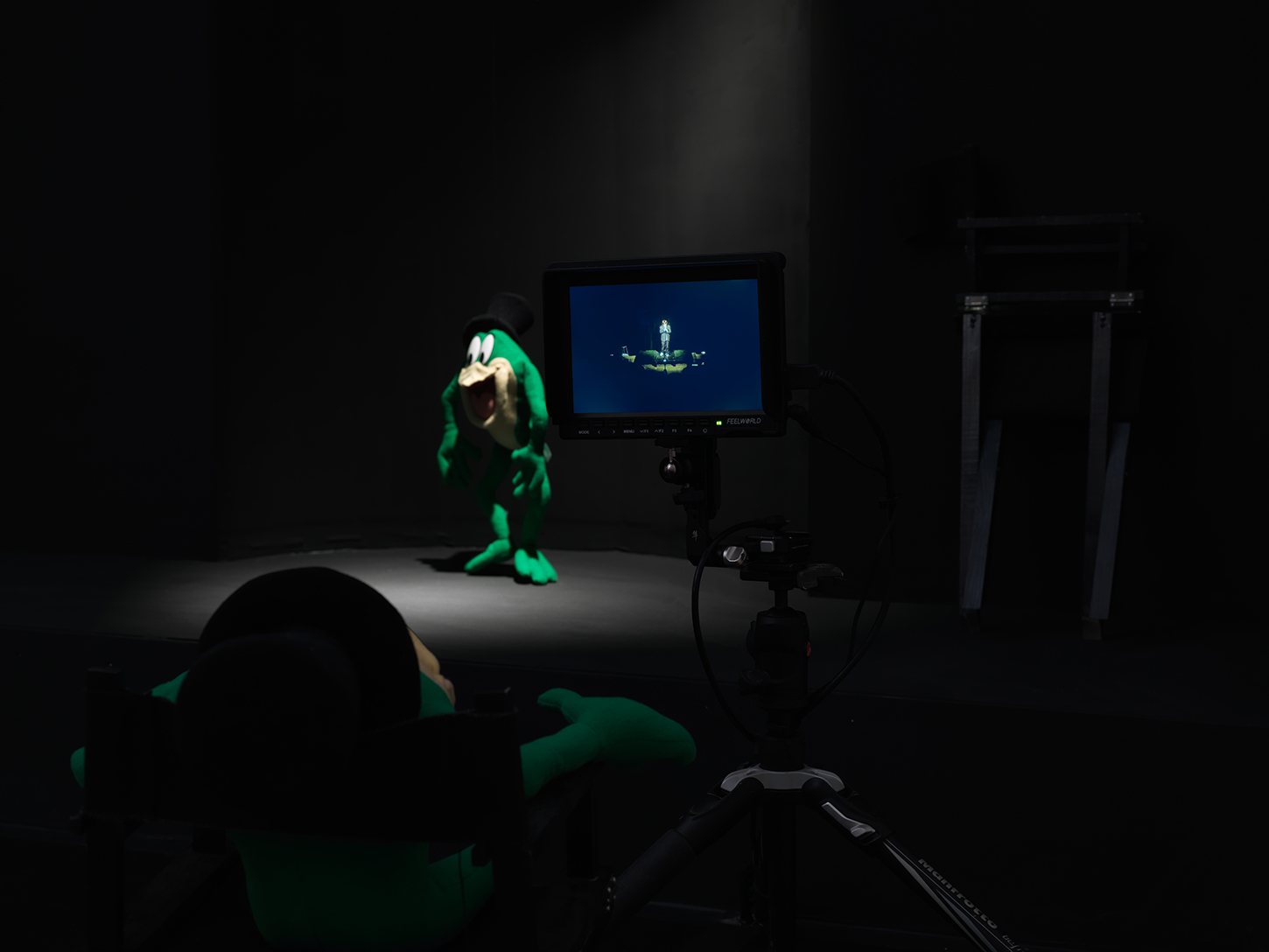
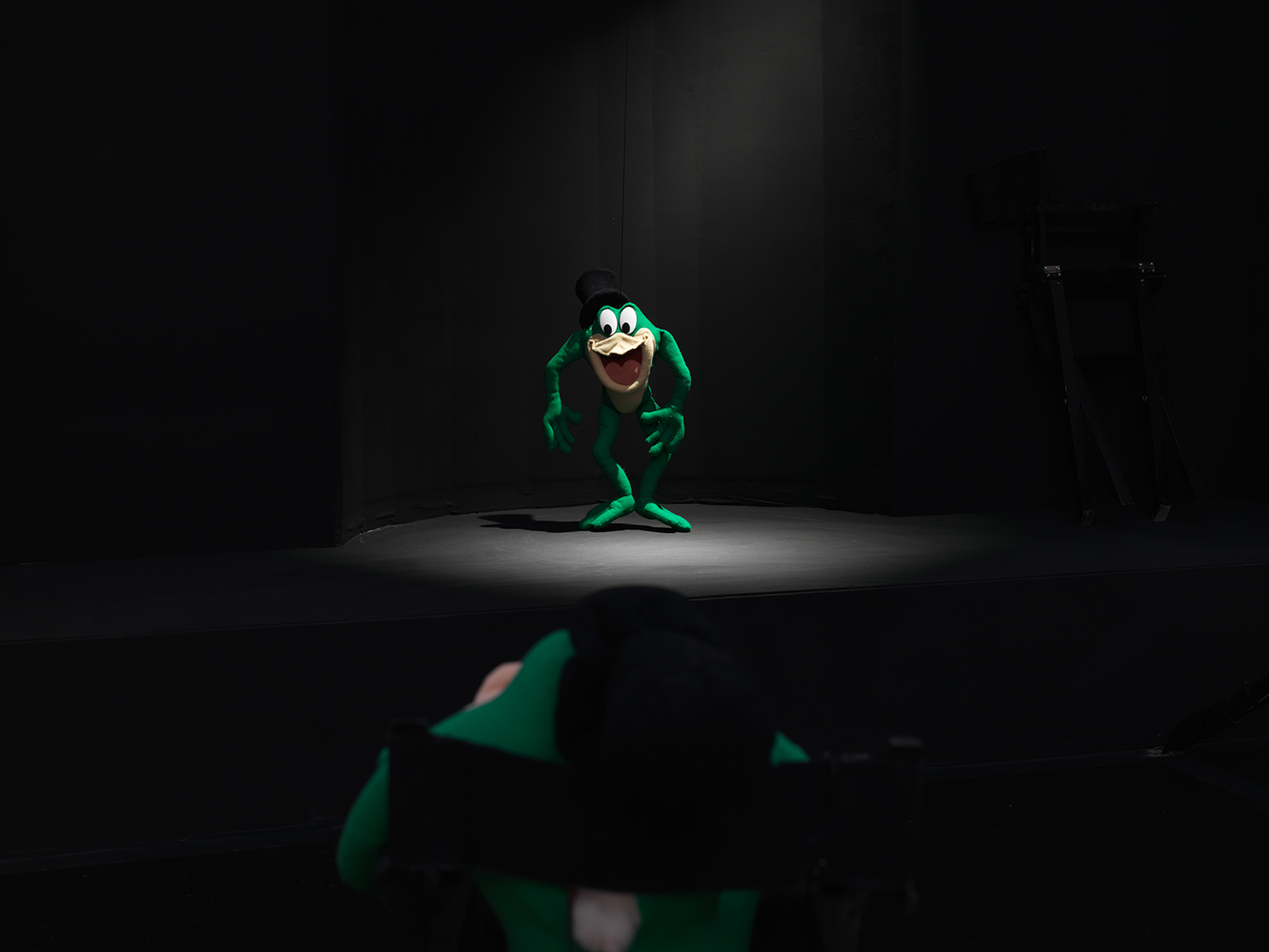
Aristotelis Nikolas Mochloulis tells a joke of an old man who lives deep in the woods with his devoted wife. He spends his days chopping and transporting wood, while she tends their garden and cares for the roses, fish, and trees surrounding their cabin. After her sudden death, he continues their routines, particularly caring for her beloved rosebush, until a series of extraordinary events tests him. Fires, earthquakes, and floods threaten the rosebud, but each time a mysterious voice—first disembodied, later revealed to belong to a frog—offers help if he consents. Miraculously, the disasters are reversed, and the rosebush is preserved. Ultimately, the frog makes an unexpected and absurdly sexual request. The man complies, and the frog transforms into a young prince. In the aftermath, the old man tells the prince that he now realizes he is gay and asks the prince how he could have known he was gay at such a young age. He replies: “I am not gay. I am a frog.”
I’ve come to realise that you never really know the people in your life. Even those closest to you—the ones you were committed to knowing, at least in outline, because their outlines were also yours. The seams where the two of you touched were not only a reassurance about the external world of which they formed a part, but also about yourself. Where you end and the world begins, as Melanie Klein would say. This line, we cling to in order to provide ourselves with a sense of control and comfort, always just beyond our reach. Before we ascribe value to anything, including ourselves, we need to know what it is we’re ascribing it to. To speak of good or bad, of wanting, of choosing, the “what” must first be made graspable.
And yet, there is a great mystery preserved in us and in others, and therefore in the world itself. A grand unknown, not only of what was and what has been, but also of what might come: how we might react in situations never before encountered, how novelty might provoke ruptures in us. How we walk forward with this unknowing—whether we tumble in fear, or engage with excited curiosity regardless of the outcome; whether we allow ourselves to feel the awe-inspiring abyss of life’s great mysteries or entrench ourselves further in artificial outlines.
And then there is storytelling, which allows us to make sense of, or at least cope with, all of this. For some it is religion; for others, art or comedy, or anything that offers tools of resolution or containment for the otherwise unruly and abysmal cataclysm that is life itself.
Any form of sanctity—any declaration of sanctity—proclaims allegiance to one order or another. Now I find myself hosting an exhibition by one of the people who has been closest to me—who reveals himself as yet another unknown: both familiar and novel, someone for whom I feel great affinity, but also someone who has, at times, inspired great fear and aversion in me. And I wonder as I experience his works, what are his allegiances? What is his particular perception of sanctity?
For years, he has had a joke that he keeps retelling. The joke keeps changing, as do its receptacles. Here, strangely, I encounter a recording of it being told to an audience in a New York theatre. I listen to it again without knowing how to feel, without knowing what would be a useful instruction to offer you. Mostly, I feel reverence in the face of this larger unknowing as it expresses itself in these particular circumstances. How can someone remain steadfast in the process of continuing to know someone?
A particular allegiance or sacred story that comes to mind in response to this question takes me back to the first four to six months of life. According to Melanie Klein, it is during these early months that a person’s identity is set on its course. Continuously revisited, re-embodied, and, in a sense, relived, this period is less a temporal stage than a psychic position—the term Klein herself favors—a kind of preset.
To fully elucidate Klein’s theoretical framework within this text would risk becoming rather pedantic, but we can tell it differently. We can tell it as a story. For, in any case, this exhibition itself is a position on storytelling.
Let us imagine a neonate and consider its mode of psychic organization. What anxieties might it face? How might the world appear—overwhelmingly confusing, perhaps even persecutory—to its inexperienced existence? When confronted with its mother’s breast, for example, can it know the breast? Can it understand that the breast belongs uniquely to its mother? Can it know its mother as a mother? And does the mother—or the breast, or the breast-mother—appear neutral, or is the neonate already attuned to its nascent sense of ethics? Does it sense goodness, badness, or everything in between, without yet having words for any of it?
The breast can be nourishing, loving, life-giving; it can also be withholding, frustrating, or persecutory. So too can the mother. Even now, at 34, I often feel overwhelmed by this possibility when I think of my own mother and her behavior. Can you imagine the anxiety such an intimate, urgent, and irresolvably mysterious confrontation might provoke in an infant? How heavily must this weigh upon the neonate’s ego, still so fragile in its pliability?
This position makes me think of the neonate as both the perfect hero and anti-hero of any story—in a sense, the earliest. Its survival contains the primal heroism of engaging reality’s overwhelming epistemological, metaphysical, ontological, aesthetic, and ethical demands. All of philosophy comes crashing down upon the infant, who, in its preverbal state, must act or perish—and in that very action, inscribe itself upon the foundations of all these philosophical disciplines. What does the infant hero do, then, in your mind? What do you imagine you did during this early challenge you demonstrably survived in order to be here today reading this text?
In our story, the neonate was overwhelmed by ambiguity. To defend itself, it allowed itself one of its first abstractions: splitting the world into wholly good and wholly bad, and then acting upon that division. During calming, nurturing experiences, it idealized and preserved the “object” associated with comfort; during experiences that provoked anxiety and pain, it disavowed and attacked the “object” associated with distress—allowing itself a crucial omission: that both objects are, in fact, one and the same. And as it split and divided outwardly, it did so internally as well, for it could not yet fully distinguish itself from the world.
If that isn’t a mode that reminds you of commonplace conversations with friends—where the actors in their lives are made wholly evil or placed on pedestals, where confidence is depleted or narcissism erected—I don’t know what is. We spend our whole lives trying to do what the hero/anti-hero of our story could not: to hold contradictions, both within ourselves and in the world, while reconciling the very division between self and world—a division we might on some level recognize as ultimately unstable.
The neonate does this instinctively. Limited in its ability to effect change—physically or verbally—upon itself or the world, it must nonetheless respond to the experiences of pain and comfort that have been thrust upon it and, in doing so, have shaped it without its consent. Seeking agency and power, the infant cannot be contained by passive imprints; it must cultivate active reflexes that, in turn, influence the objects with which it is in dynamic relation.
That’s when the infant begins to phantasize. The infant imagines that split-off parts of itself are projected into these other objects—typically the mother, but it could also be its plushies or anything in its environment—and not only projects unwanted feelings, such as aggression and frustration, but conceives these parts as taking possession of the “external” object. Its psychic imagination finds a host in them. It colonizes them. And that’s where it gains its first foothold of power as it reintrojects the object in a transformed or distorted form, identifying with it simultaneously. In other words, the infant harnesses—or even deploys—its sense of self against the world, shaping it, harmonizing with it, or amplifying it. And the world is, in turn, shaped by the infant’s expressions, as these are morphed by phantasy. As ruthlessly as the world confronts it, it confronts the world back. Without hesitation or mercy, it automatically dispenses punishment and reward.
This cycle repeats until, gradually, the infant moves into another position, one seemingly closer to an adult understanding of the world. It begins to recognize its own outlines, and the outlines of others, and as things begin to form more stable identities, it must also reconcile the judgments it previously made. For now, it knows that the good and bad breast are one and the same. That the loved and hated object are one and the same. And isn’t that a grave disillusionment? How terrible must that feel? How grounding? How shocking and how depressing.
Then comes a second wave of emotion—for if that’s the new state of the world, it suddenly means there’s newfound space for guilt, and then loss and mourning. Our hero/anti-hero finds itself in the echo of the wounds it has delivered to the loved object, and the wounds the loved object has delivered upon itself. Reciprocal betrayal. Guilt and resentment. Now, this position is so familiar in adulthood. In relationships, definitely. In relationships with ideas and values, too. It is one of the most popular positions we rotate in and out of throughout our lives.
It is by no means guaranteed that we recover each time. Nor is it guaranteed that we remain as honest as the infant in the face of what it expresses. Unlike that early hero, however, we later fortify ourselves with an additional position: the position of the lie. This lie is not the same as early phantasy, yet it is not entirely different either. Motivated by unconscious experience, it is often captured by the dominant weaknesses we accumulate along the way.
The system we continuously negotiate as part of our social organisation—the rules we apply, the ethical tenets expressed in law or in the court of public opinion, and so on—consists of abstractions, relieved of their arbitrariness mostly through agreement or coercion rather than through psychic truth or lived experience. For can one imagine a system as wild as one’s own experience of life? How overwhelming are the implications of a system founded on a single, profound admission: that everything is permissible, because everything is true—even the lies.
Now the infant won’t as easily deflect or avoid as we might, and so in this position, it is confronted with a reckoning. How to overcome the grief, the guilt, the sadness? And move on to repair and love, and a restoration of its desire? How to move, in other words, out of the pessimistic distortion of depression and into the crisp spotlight of radical acceptance?
As I read Kierkegaard’s Fear and Trembling, I simultaneously consider his neonatal counterpart and wonder what singular experiences in those first few months of life must have forged the psychic fortitude implied throughout his work—beautifully captured in this line: “For my own part, I don’t lack the courage to think a thought whole.” For to think a thought whole is, in part, to embrace life itself and move away from the depressive position.
Now Kierkegaard conflates this notion with that of faith, insofar as I can discern. Ultimately, it is his love for Abraham—as the true embodiment of faith—that becomes the narrative vehicle through which he seeks to inspire in us a similar devotion.
I am perhaps less concerned with the particularities of faith in Kierkegaard’s thought than with the broader implications of his endeavor. Put differently, if we are to craft a story out of Kierkegaard—much as we did with Klein, and as he does with The Binding of Isaac, the central subject of his book—we can explore a new allegiance to sanctity: another narrative with which to fortify our experience of the world, and to reckon with the neonate hero—or anti-hero—within us.
It is no accident, in this regard then, that both hero (Abraham) and infant appear as literary counterparts in his Attunement chapter, where each retelling of Abraham’s story is paired with a depiction of weaning—the process by which a child transitions from breast milk or formula to solid foods. But before we arrive there, we must rewind this story to its lovely preface.
The preface begins with a man who harbors a particular resentment toward the status quo. He surveys the culture of his time and observes what he calls a great “bargaining,” in which those who call themselves philosophers—and are recognized as such by the system—dispense doubt recklessly and without integrity. They proceed to question everything and dismantle all certainties, yet propose no path forward. In other words, Kierkegaard finds himself in an environment, which he perceives as ultimately lazy and cowardly, where doubt is not cultivated as a skill to be followed by the restoration of faith, but is used instead as an escape.
Now Kierkegaard, who in that same preface declares that he is not a philosopher but a poet, proceeds to revere doubt as much as he does faith—both as skills that demand a lifetime of cultivation and are, ultimately, necessary endeavors. For, as he pointedly observes of those philosophers, they may denounce faith, yet they continue to live—a life that, in itself, requires a form of faith–a life that, without faith, would come to an immediate end. And so what Kierkegaard—writing at this moment under the pseudonym Johannes de Silentio, meaning “John who does not speak”—is truly pleading for is, above all, a form of honesty that demands immense strength for it entails a reckoning not unlike that which the infant faced earlier in our story.
And then comes his Attunement—sometimes also translated as Prelude, a title well suited to its poet-author. Here, resentment gives way to admiration and wonder, centered on a singular figure: Abraham, commanded by God to sacrifice his son Isaac. This is as omnipresent a story as one could find, appearing across multiple religions in various iterations, yet it is often dismissed too quickly because of its renown. The mystery of Abraham, Kierkegaard observes, lies in its profound complexity—not only in the variations of its telling, but in the demands it places on the reader. It can be easily misunderstood conceptually, but it also exacts a heavy emotional and spiritual toll. How, after all, is one to perceive Abraham not as a passive sheep, nor as the ultimate submissive, but as a man whose faithful heart enabled him to bring Isaac to Mount Moriah without sin or cruelty? Kierkegaard himself declares his longing to have seen Abraham, to have witnessed those events, to have experienced “the shudder of thought” alongside him.
Unable to act directly, he does so through phantasy. In the Attunement, he retells the story four times, each time pairing it with a corresponding account of weaning.
In the first telling, Abraham decides to reveal to Isaac what is about to happen, but Isaac cannot comprehend him. To preserve his son’s faith in God, Abraham lies and turns himself into a monster: “Foolish boy, do you believe I am your father? I am an idolater. Do you believe this is God’s command? No, it is my own desire.” In this account, Abraham sacrifices himself in order to safeguard the faith of his audience. In the corresponding story of weaning, Kierkegaard speaks of a mother who blackens her breast so that the child believes the breast has changed while she-as mother remains the same—loving and tender as before.
In the second telling, the mother virginally covers her breast and the child loses its mother. Abraham, as always, draws the knife—but this time, silently. From that day on, his eyes darken; he no longer sees joy and cannot forget that God has demanded this of him, even as Isaac thrives as before.
In the third telling, Abraham regards his own willingness to sacrifice Isaac—referred to in this iteration as his “best”—as a sin. He asks God for forgiveness but finds no peace. The mother, meanwhile, grows sorrowful, and that sorrow contributes to a gradually widening distance between herself and her child.
In the fourth and final iteration, Abraham’s left hand is clenched in anguish, and yet he draws the knife—but this time from a place where faith is lost. The story is no longer what it once was; never a word of it is spoken in the world. Meanwhile, the mother keeps solid food at hand, fearing the child will otherwise perish—having, in other words, lost her faith as well.
Now, who is able to grasp what each of these iterations truly sacrifices, and how together they conjure an understanding of faith through Abraham? The remainder of the book attempts to elucidate this question. Kierkegaard convincingly argues that the only way to preserve not only faith, but also Abraham himself, is to imagine that he awoke that morning almost excitedly, and without hesitation proceeded to Mount Moriah. When the moment came to draw the knife, he again hesitated not, but fluidly inhabited the action that his faith had inscribed.
The only way Abraham could have done this—without being a cruel psychopath, a mindless automaton, or even a masochist—was if faith itself made him aware of faith. Faith no longer deals with a dynamic of dominance and submission, but with an inescapable equilibrium in which things are as they are, as they should be. This might tempt us toward a deterministic cul-de-sac—but that is another story. What is truly inspired here is the idea, or the embodiment of the idea, that faith is nothing other than the full restoration of the splitting imposed upon humanity in its neonatal state. It is a great response also, to the depressive position. It is comfort without bargaining.
There are so many wonderful ideas explored later in the book, and it is a shame we cannot go through them all here—but I suspect I have already taxed your patience. So let us say this: if we allow ourselves, even for a moment, to imagine being this Abraham, then it no longer matters if we appear a mockery to the world. It no longer matters if we age, if we lose things along the way, if we endure pain. For we have reckoned with what Kierkegaard calls the subtle power that invents everything—time itself. With every tribulation we face, with every grand unknowing we encounter, we remain steadfast in the process of coming to know life.
In the outward world, perhaps—as Kierkegaard notes—“it happens time and time again that one who gets bread is one who does not work, that one who sleeps receives it in greater abundance than one who labors. In the outward world, everything belongs to whoever has it.” But while that world is governed by the law of indifference, the world of spirit is different. There, “only he who works gets the bread, only he who knows anguish finds rest, only he who draws the knife gets Isaac.” Conventional wisdom, or the System, may presumptuously seek to impose the law of indifference on the world of spirit, assuming that mere knowledge of greater truths is enough—but then it receives no bread.
One must labor to understand Abraham; one must labor to feel the anguish of his faith, to marvel at his deed—to comprehend the distance between what he was capable of and what most people can achieve—to then grow closer to the comfort that was lost in those earliest months of life.
The point here is perhaps less about the validity of Klein’s theories or Kierkegaard’s poetics, and more about their resonances and allegiances to particular forms of sanctity—forms that appear, but also fall short, in Aristotle’s joke or anti-fable.
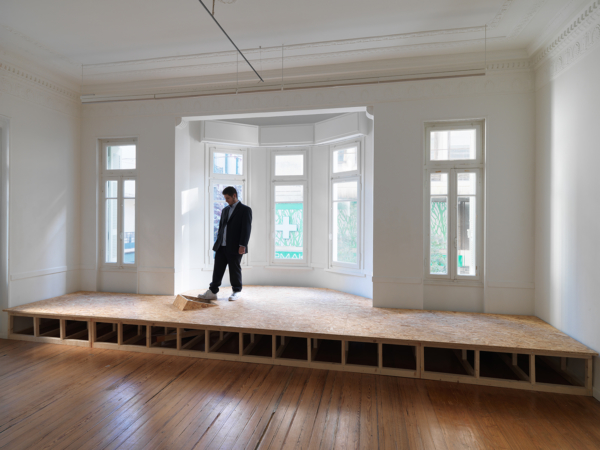
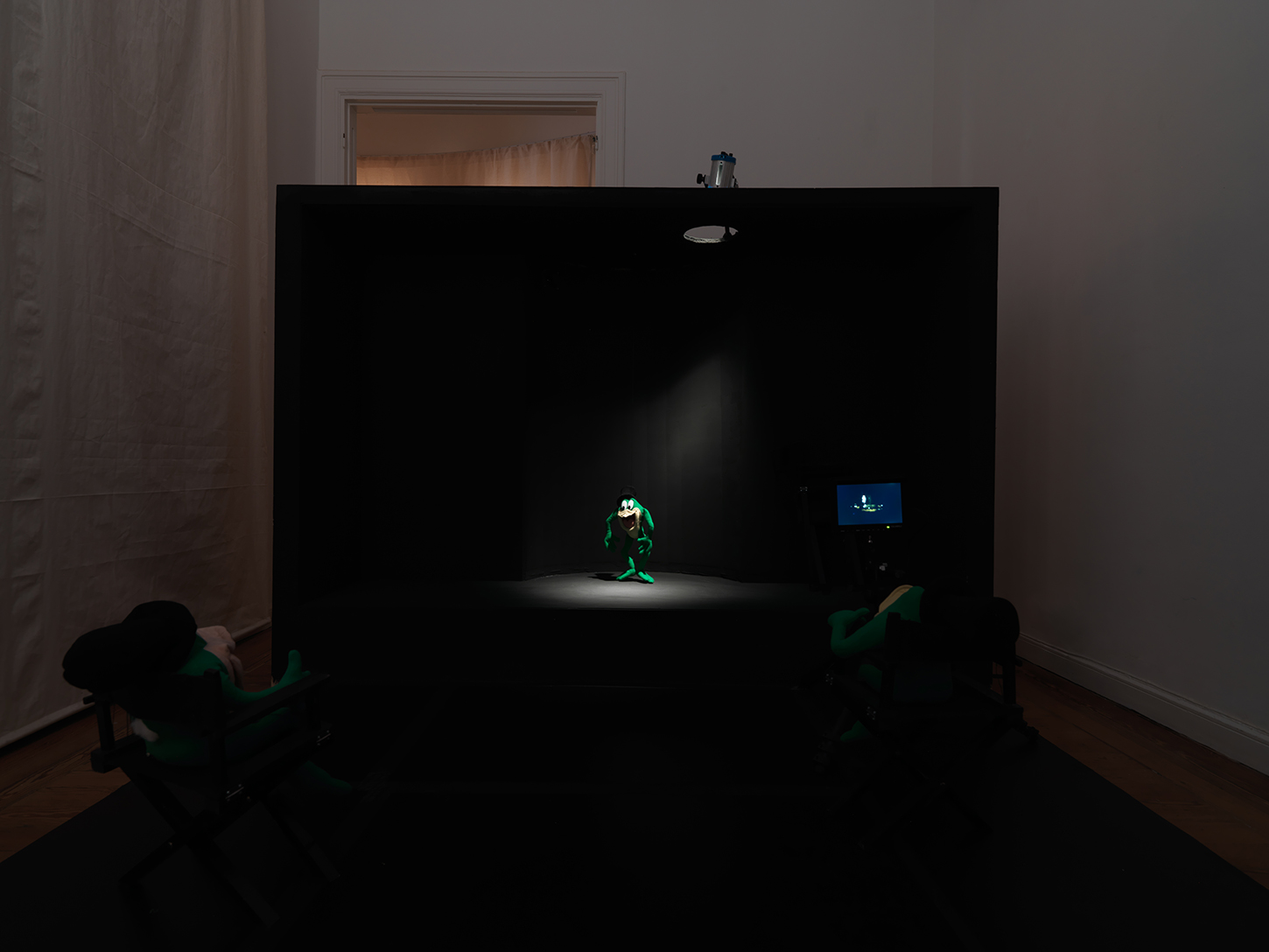
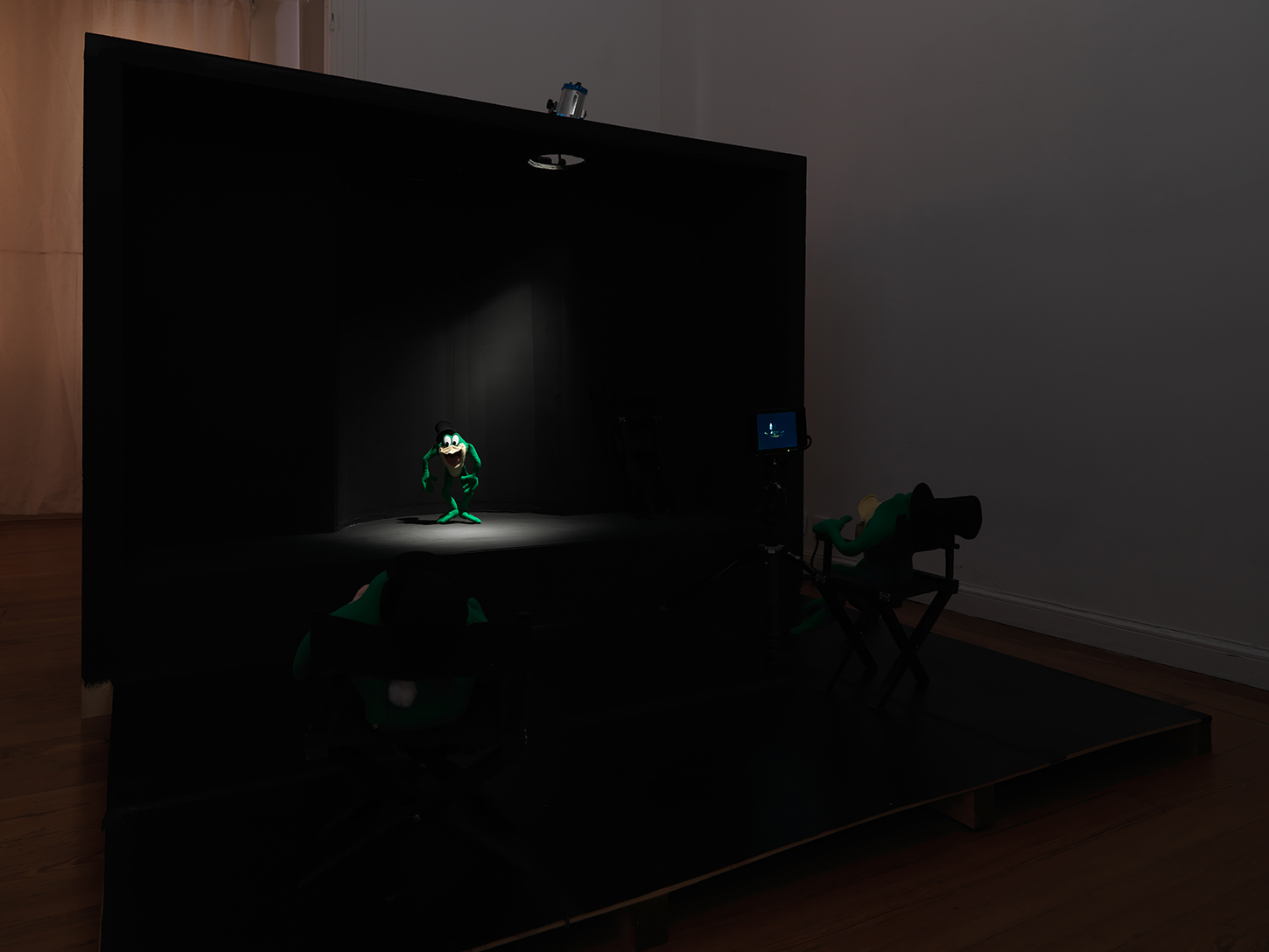
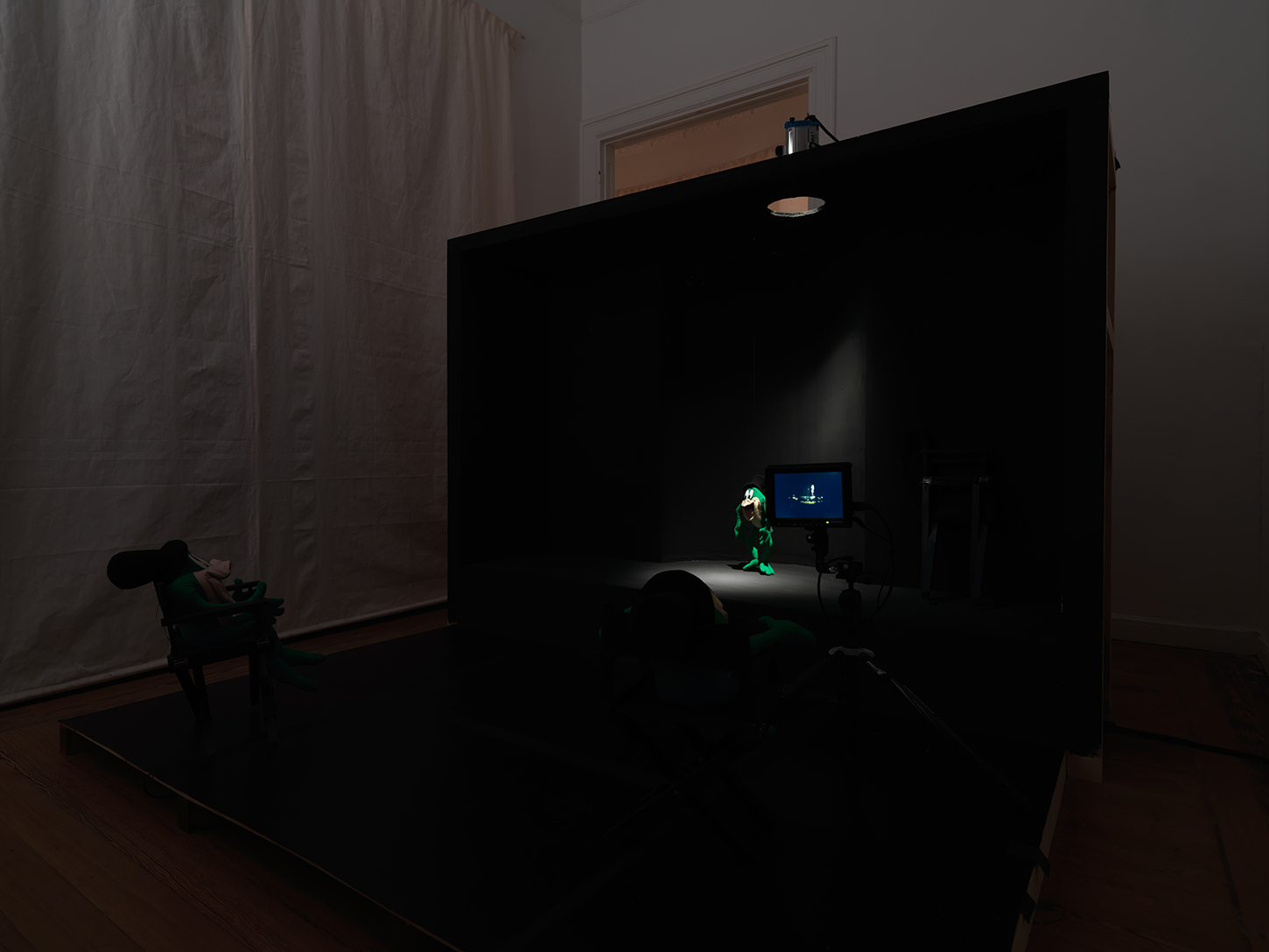
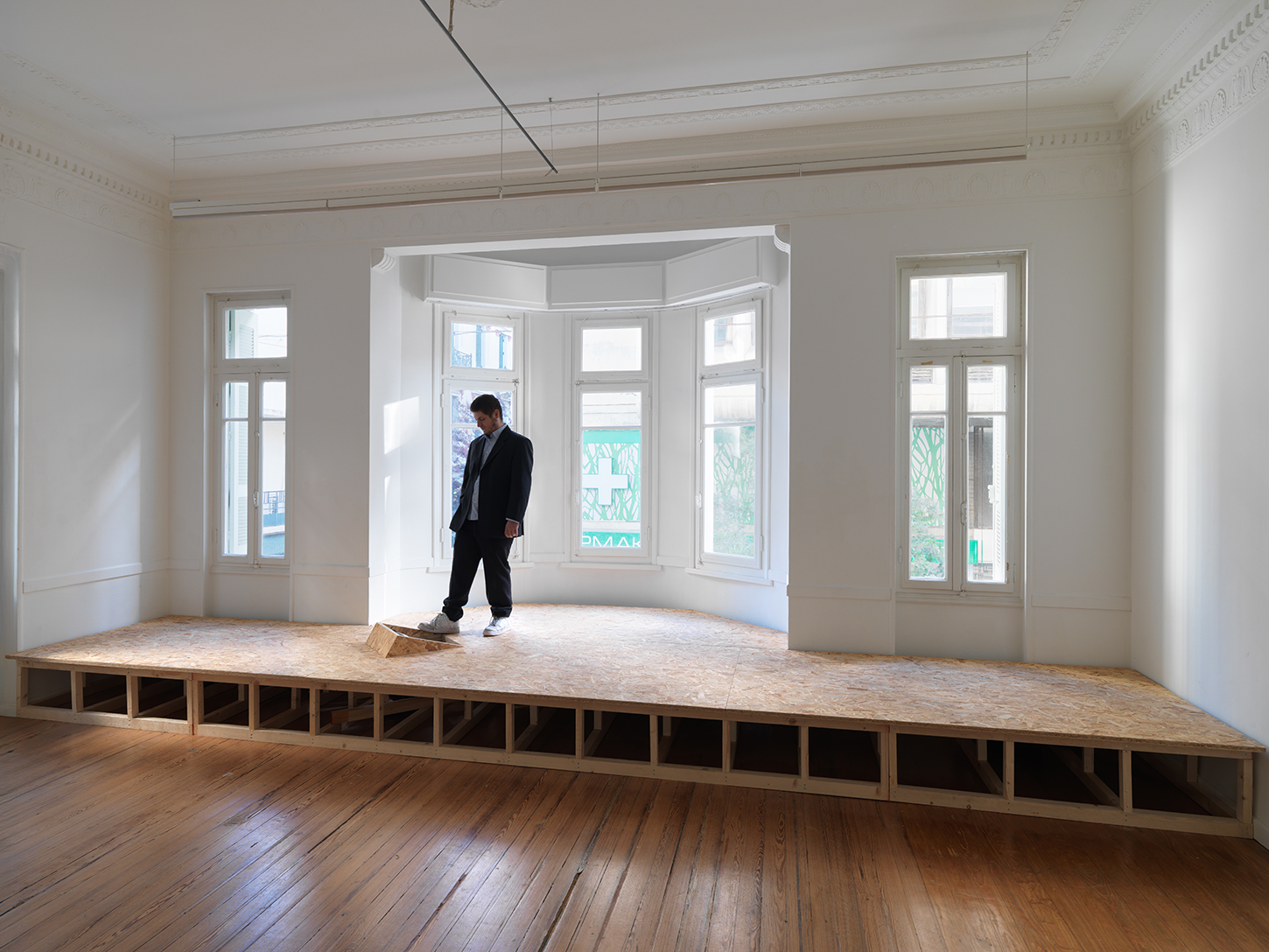
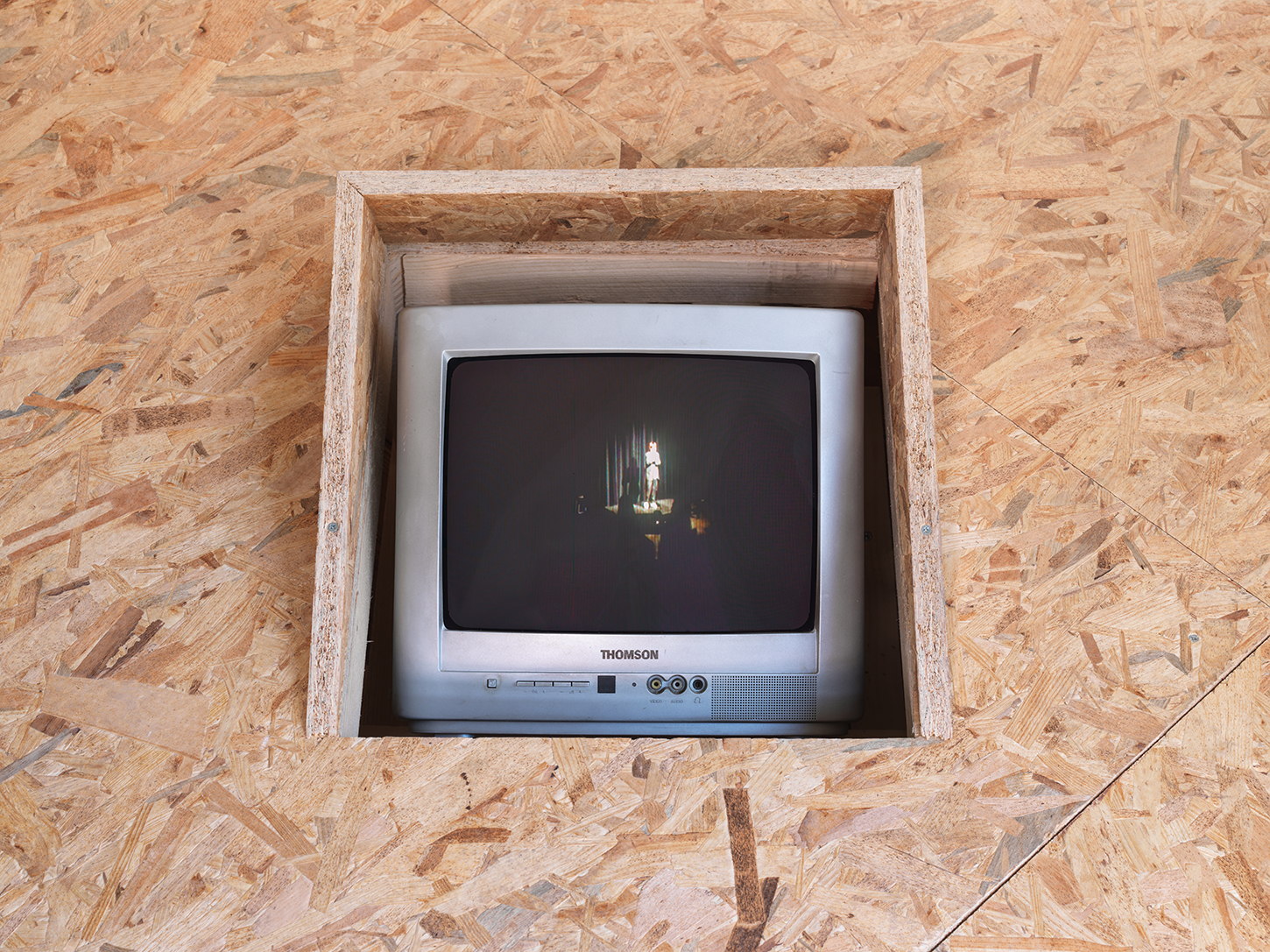
There, we encounter Kierkegaard’s philosophers again, in their various iterations. The frog confronts the old man’s dishonesty, seemingly recognizing that the old man cannot hold the full complexity of his experience and must resort to splitting—but the frog offers no path forward, as he does not engage with faith either. The only place we can faintly sense the outlines of Abraham is in the exhibition itself: in the mirroring of the life-sized stage and the miniaturized one, in the multiplication of the recorded performances of the joke, and in the animation of plushies as projections of storied characters. There, one begins to glimpse what it means to hold a complete thought: to admit its artifice without delivering judgment. To continue to know it.
— Maya Tounta
Exhibition documentation: Stathis Mamalakis.
The exhibition was made possible through the generous support of the Carved to Flow Foundation.
Photograph of Aristotelis Nikolas Mochloulis (2025) by Maya Tounta, B&W film, silver gelatin print, scanned. Courtesy of the artist and Maya Tounta.
ελ.
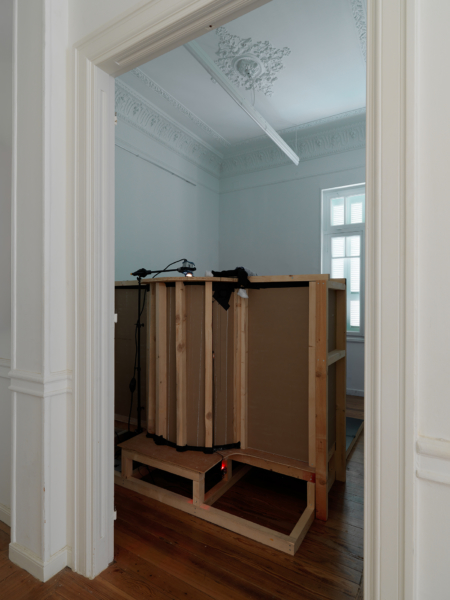
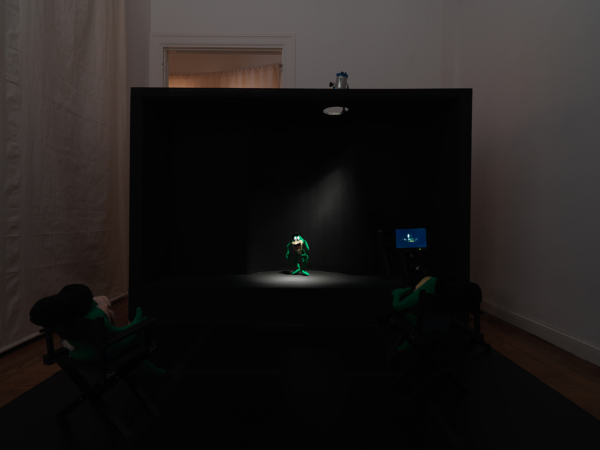
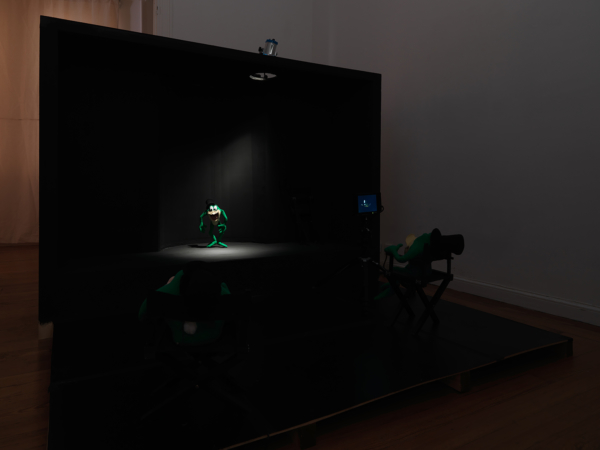
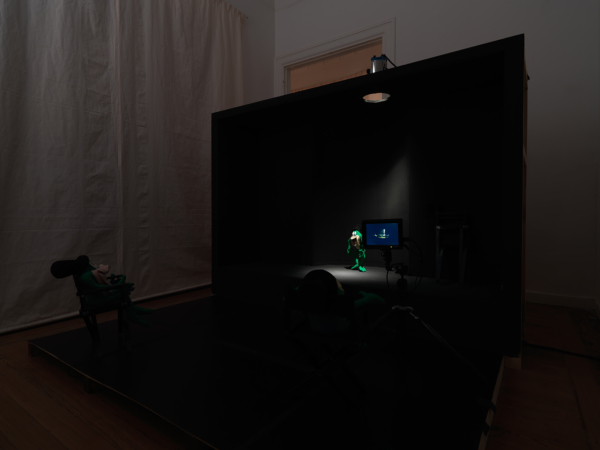
Μέσα από ηχογραφήσεις, μινιατούρες και θεατρικές υποδομές, η έκθεση Υποστηρίζοντας έναν νεαρό άνδρα στην αρχή της καριέρας του εξετάζει τι σημαίνει να «υποστηρίζεται» κανείς και ποιος εντέλει—καλλιτέχνης, τέχνη ή κοινό—αναλαμβάνει αυτόν τον ρόλο. Η έκθεση δομείται γύρω από δύο βαθμίδες θεατρικού χώρου: η μία 1:1, αλλά αφαιρετικά απογυμνωμένη στα απολύτως βασικά της στοιχεία· η άλλη αποτυπωμένη πιστά και λεπτομερώς, αλλά αποδοσμένη σε κλίμακα μοντέλου.
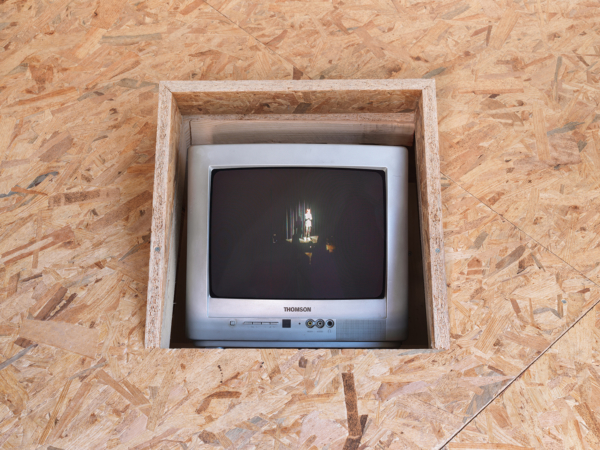
Σκηνές από πρόσφατα έργα του Μοχλούλη — συμπεριλαμβανομένου ενός stand-up στο Amant (5 Νοεμβρίου 2025, Νέα Υόρκη), μιας ξενάγησης στα παρασκήνια του Frog Man & Baby Frog στο Artists Space (17 Οκτωβρίου 2025, Νέα Υόρκη), και μιας περφόρμανς που θα λάβει χώρα στα εγκαίνια της ίδιας αυτής έκθεσης (20 Δεκεμβρίου 2025) — παρουσιάζονται παραλλαγμένες και μεταβλητές. Οι φωνές μετατοπίζονται ή αφαιρούνται: μερικές φορές παραμένει μόνο ο ήχος του κοινού, άλλες φορές αναπαράγονται ηχογραφήσεις εκτελεσμένες από διαφορετικά σημεία στον χώρο. Η αλληλεπίδραση με αυτά τα στοιχεία — συμπεριλαμβανομένου ενός αστείου με έναν βάτραχο και έναν άνδρα, που ο Μοχλούλης έχει γράψει και επαναλαμβάνει τελετουργικά μέσα στα χρόνια — πραγματοποιείται μέσα από μια άτυπη σειρά κινήσεων που καλείται το κοινό να εκτελέσει. Κεντρικό στοιχείο της έκθεσης αποτελεί μια οθόνη/υποβολέας που περιέχει βιντεογραφημένο υλικό, η οποία είναι προσβάσιμη μόνο ανεβαίνοντας στη σκηνή· μια συνθήκη που προϋποθέτει μια επιπλέον, δημόσια διάσταση θέασης του έργου.
Μινιατούρες και λούτρινες φιγούρες λειτουργούν ως ομότυπα σε αντιστοιχίες: λούτρινοι βάτραχοι Michigan J. Frog κάθονται σε μικρές καρέκλες σκηνοθέτη· ένας μικρογραφικός Μοχλούλης απευθύνεται σε έναν βάτραχο-γονέα και παιδί· μια κάμερα με πρόσθετη οθόνη αναπαράγει το αστείο βιντεογραφημένο από άλλες πλευρές. Το χιούμορ είναι σκοτεινό και στρεβλό, σηματοδοτημένο από άρνηση, επιθυμία και δυσφορία· οι ρόλοι εκτελεστή, παρατηρητή και χαρακτήρα είναι διαβρωμένοι. Σε όλες τους τις κλίμακες, τα έργα αντιστέκονται σε απλή ερμηνεία, σχηματίζοντας αντίθετα, μεταβαλλόμενα ίχνη για το τι είναι το κοινό—ή τι ο καλλιτέχνης φαντάζεται ότι είναι ένα κοινό. Το είδος προσέγγισης και αναστοχασμού του Μοχλούλη ως «νεαρού καλλιτέχνη» είναι στην ουσία μια απόπειρα συνάντησης με τον εαυτό του, που μέσα από στοιχεία δικής του δημιουργίας—επιθυμίες, παρορμήσεις και προβολές—διαταράσσει, όσο οικοδομεί, τις ίδιες αυτές αφηγήσεις.
Οι πιέσεις του να υποστηρίζεται κανείς, το βάρος των κοινωνικών προσδοκιών και η ελπίδα ότι η τέχνη μπορεί να επιλύσει ερωτήματα ταυτότητας καθιστούν αυτή τη διαδικασία ταυτόχρονα συνδετική και ανασταλτική. Η πρόθεση του Μοχλούλη —δοκιμαζόμενη και αμφισβητούμενη μέσα από τα έργα του— χαράσσει έναν χάρτη που επιτρέπει τόσο τη συγχώρεση όσο και την αναγνώριση.
Η έκθεση πραγματοποιείται με την ευγενική υποστήριξη του Carved to Flow Foundation.
Φωτογραφία του Αριστοτέλη Νικόλα Μοχλούλη (2025) από τη Μάγια Τούντα, ασπρόμαυρο φιλμ, αργυροτυπία, σαρωμένη. Ευγενική παραχώρηση του καλλιτέχνη και της Μάγιας Τούντα.